
Chimney Repairs & Leadwork in Bournemouth & Poole
This is where most roofs leak, and where most corners get cut. Lead is slow to do properly and quick to do badly, so it is worth knowing what you are paying for.
What is included on any leadwork job
The details that decide whether it lasts twenty years or two winters.
The right code of lead
Lead is graded by thickness. Too thin for the span and it splits where it moves, usually inside a couple of winters. We use code 4 and above depending on what the detail asks for.
Chased and wedged properly
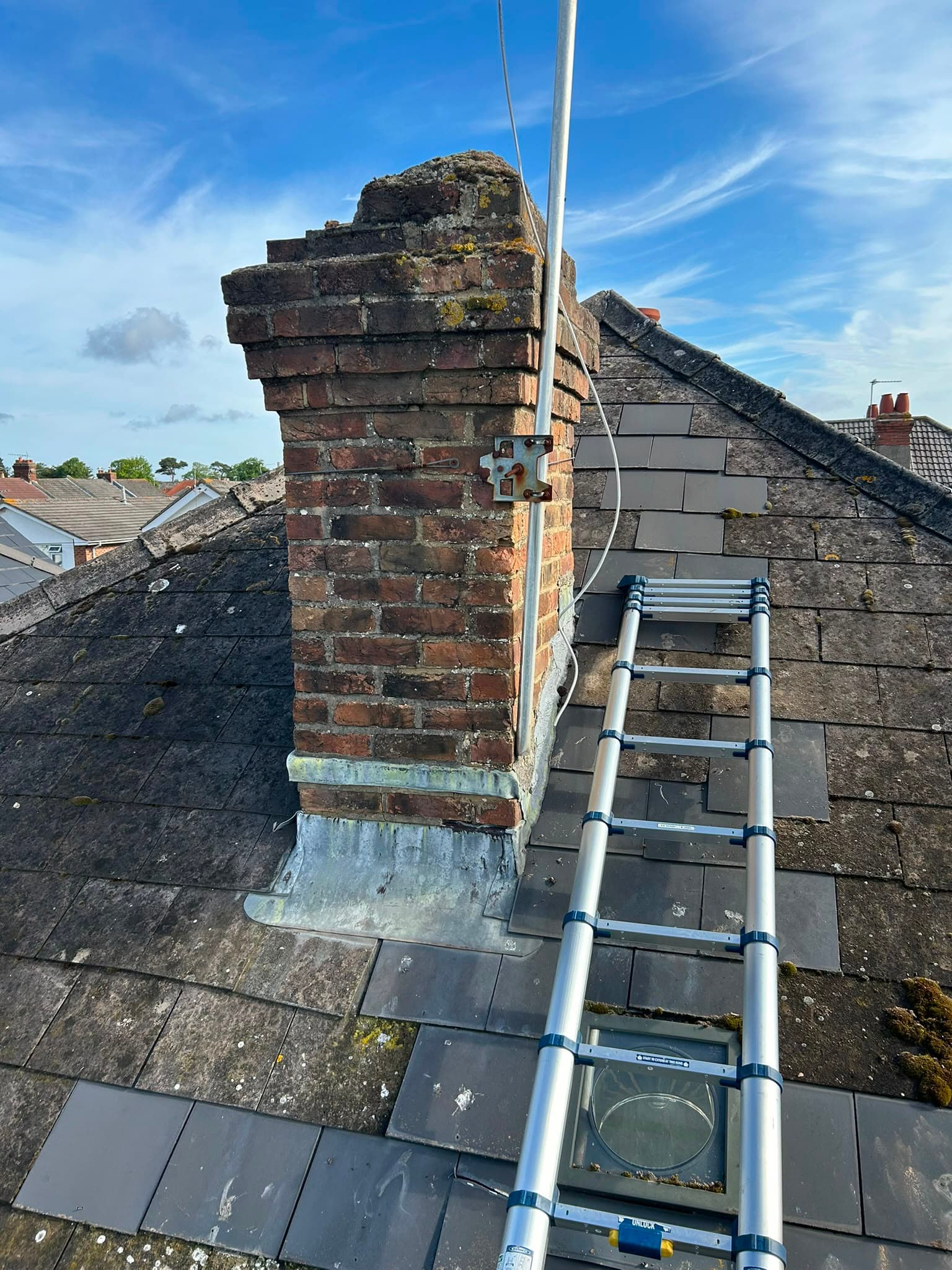
Flashing is cut into the mortar joint and wedged, not stuck on the face of the brickwork with sealant. Sealant is a repair on somebody else's shortcut, never a detail in its own right.
Room to move
Lead expands and contracts a lot with temperature. Runs are kept to the right length with proper laps so it can move without tearing itself.
Patination oil on new lead
New lead is oiled so it weathers evenly instead of streaking white carbonate down the tiles below. It is a small job at the end that saves a stained roof.
The roof closed properly after a removal
Taking a chimney down is only half the job. The hole it leaves needs new rafters, felt, battens and tiles that match, or you have swapped one problem for another.
Photos of what we found
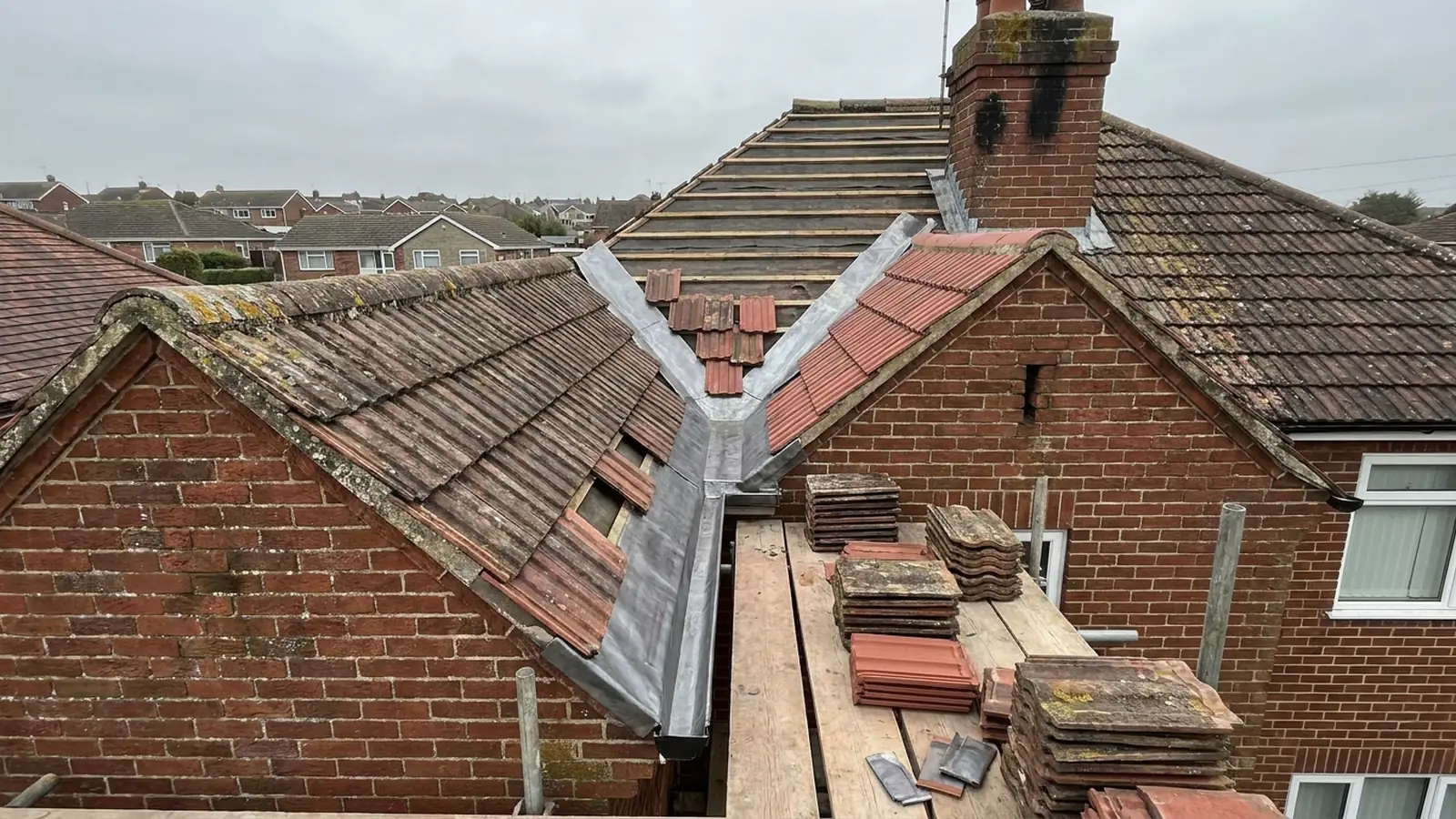
Chimneys and valleys are the least visible parts of a roof. You get pictures of the state it was in and the finished detail, so you are not taking our word for it.
Leadwork and chimney jobs
Including the Dorchester repair, where a lead flashing fix took about four hours and saved a roof somebody else had quoted to replace.
Captions name what was done and where.
How a chimney or leadwork job runs
A flashing repair can be a few hours. A rebuild or a removal needs scaffold and a day or more.
We find out whether the chimney is the problem
A damp patch on a chimney breast is not always the flashing. It can be the flaunching, the pot, the pointing or a redundant flue drawing damp. We work out which before quoting.
Access sorted
Small flashing repairs can often be done off a roof ladder. Anything involving the stack itself needs scaffold, and we will tell you which yours is.
The old detail comes out
Failed lead, cracked flaunching or loose pointing is cut out rather than covered. Sealant over a failed flashing buys a winter at most.
The new detail goes in
Lead chased into the joint, wedged and dressed. Brickwork re-pointed or rebuilt where it has gone. Flaunching re-formed around the pots.
Oiled, cleared and checked
New lead oiled so it weathers evenly, debris cleared out of the gutters and valleys below, and the finished detail photographed.
What customers say
We are a new company and we are building this up honestly. These are the jobs people have been kind enough to comment on.
George Gudge
Can't recommend Southern Counties Roofwork highly enough. I had them out for full re-roof / fascias & guttering - and the whole experience was spot on. Great communication, gave me a clear quote and explained everything properly. The team were punctual, polite, hardworking and obviously know their trade. The finished roof looks brilliant and is built to last. No mess left behind either.
Jacey Arnold
Recently had this company out to have my roof repaired after having problems with leaks during the winter months and something I had been looking to get sorted. The guys came out to take a look at the issues before quoting, once a quote was given work was agreed and I went ahead. Extremely professional, reliable and hard working! Would highly recommend this company and would definitely use again.
Celine Fox
Owen and Sam did a fantastic job with our roof. They were professional, reliable, friendly, and clearly take pride in the work they do. The work was completed to a really high standard, and everything was left clean and tidy afterwards. I’d definitely recommend to anyone looking for a trustworthy roofing company. Great service from start to finish!
Re-point it, rebuild it, or take it down
If your chimney is in a bad way these are the three options, and the right one is usually decided by whether you still use the flue.
| Re-point and re-flaunch | Rebuild the stack | Take it down | |
|---|---|---|---|
| Right when | The brickwork is sound and the mortar has gone | The brickwork itself is spalled or leaning | The flue is redundant and you want rid of the upkeep |
| Scaffold needed | Sometimes | Yes | Yes |
| Typical run | Under a day on most stacks | A day or more | A day, plus closing the roof |
| What it fixes | Water getting in through open joints | A stack that is structurally past re-pointing | The problem permanently, and the maintenance with it |
| Worth knowing | The cheapest of the three and often all that is needed | You are rebuilding something you will still have to maintain | The roof has to be closed properly or you have a new leak |
Swipe to see every column
Why leadwork is where roofs are won and lost
Tiles and slates shed water. They do not seal anything. Everywhere the roof stops being a plain slope, at a chimney, a wall, a valley, a parapet, something else has to make the joint watertight, and on almost every house in this country that something is lead.
Lead is used because it lasts and because it can be dressed to fit an irregular shape by hand. The trade-off is that it moves a great deal with temperature, more than most building materials, and it will tear itself apart if it is not given room. That is why lead is laid in limited lengths with proper laps, and why a long unbroken run split down the middle is the commonest lead failure we see.
The second commonest is thickness. Lead is graded by code, and a code that is too thin for the span fatigues where it flexes. It is cheaper to buy and quicker to dress, which is exactly why it turns up on jobs that were priced too keenly. We use code 4 and above depending on what the detail needs.
The third is sealant. A bead of mastic over a failed flashing looks like a repair and behaves like a delay. It hides the joint, it fails within a winter or two, and it makes the eventual proper fix messier. Flashing belongs cut into the mortar joint and wedged, not stuck to the face of the brick.
None of this is exotic. It is just slow, and it is the first thing to get rushed. The Dorchester job is the example we would point at: a lead flashing repair that took about four hours on a roof that did not need replacing. Somebody could have sold that customer a roof. We fixed the flashing instead, and that is the whole business in one job.
Questions about chimneys and leadwork
There is damp on my chimney breast. Is it the flashing?
Often, but not always. It can also be cracked flaunching around the pots, open mortar joints in the stack, a missing or damaged pot, or condensation in a flue that is no longer used. We work out which it is before quoting, because the fixes are very different.
Can you just seal it?
We would rather not. Sealant over a failed flashing hides the joint and fails inside a winter or two, and it makes the proper repair messier when it comes. Lead chased into the mortar joint and wedged is the detail that lasts.
How long does lead flashing last?
Properly specified and dressed, decades. Lead itself does not really wear out. What fails is lead that was too thin for the span, run in lengths that were too long to move freely, or fixed to the face of the brickwork instead of into it.
Should I take my chimney down?
If the flue is genuinely redundant and the stack needs work, it is worth considering, because it removes the maintenance permanently. If you still use the fire, or might, then repair it. Either way the roof has to be closed properly afterwards with new rafters, felt, battens and matching tiles.
Do you do valleys and box gutters?
Yes. Valleys, parapet linings and box gutters are all lead work and all common leak points, because every bit of water on two slopes gets funnelled through them.
Why has my new lead gone white and streaked the tiles?
Because it was not oiled. New lead forms a white carbonate as it weathers and the rain washes it down the roof. A coat of patination oil at the end stops it. It is cosmetic rather than structural, but it is avoidable.
- Service
Roof Repairs
Leaks, storm damage and ridge work on pitched roofs.
Learn more - Service
Roof Replacement
Full pitched roof replacements when the covering has had it.
Learn more - Service
Flat Roofing
Garages, extensions, dormers and porches.
Learn more - Service
Roofline & Guttering
Fascias, soffits, bargeboards, guttering and downpipes.
Learn more
Where we do chimney and lead work
Based in Bournemouth, working across the conurbation and the towns just outside it.
Get the flashing looked at before it costs you a ceiling
Most chimney leaks are a detail, not a roof. We will find out which yours is and tell you straight.
Get a free quote
Tell us what you need and we'll come back with a price. No pressure, no hard sell.
Prefer to talk? Call Southern Counties Roofworks Ltd on 07895 305286